CELPIP Speaking Task 4 Template (Making Predictions)
Discover how to make logical predictions, link them to scene details, and impress examiners with clear, fluent English in CELPIP test.
 Matthew ZareCELPIP Teacher
Three levels of certainty
- Opening
In the next few minutes, I imagine that...
- Going to
The [Person] is going to finish [Current Action].
- Will
After that, the [Person] will probably [Next Logical Action].
- Might
The [People] might decide to [Social Action: talk/eat/rest].
- Ending
Finally, the day will come to an end.
CELPIP Speaking Task 4 in short: you see the same picture you described in Task 3, with one question: what do you think will happen next? You get 30 seconds to prepare and 60 seconds to speak. Make a few predictions about the people in the picture, link each one to something you can see, and show how sure you are with "going to", "will" and "might". The template below is the frame. The words should be yours.
Print it: this Task 4 template, and the other seven, are in our free CELPIP Speaking templates PDF. One page per task, no sign-up.
Video lesson· 10:41
Two answers, same picture, same 60 seconds: five times and zero times
Jump to13
Your Task 3 notes are your Task 4 notes. The video answers the same picture twice and asks you to count one thing while you listen, then reveals why one answer scores and the other does not. Four moves, with the best sentence first, not last.
CELPIP Speaking Task 4: How to Predict the Same Picture from Task 3
The full CELPIP Speaking Course is free: CELPIP Speaking Course · More lessons on the CELTESTPIP YouTube channel
Goal
Look at the same illustration from Task 3 and describe what you think will happen next (that is how CELPIP itself describes Task 4). Use what you can see in the image to support your predictions, and use a variety of future forms to show how sure you are.
What does CELPIP actually rate on Task 4?
Every Speaking task is rated on the same four dimensions. This is CELPIP's own list of what raters look at:
| Dimension | What raters look at | What it means on Task 4 |
|---|---|---|
| Content/Coherence | Number and quality of ideas, how they are organized, examples and supporting details | A few predictions, each linked to something in the picture, in a clear order |
| Vocabulary | Word choice, suitable words and phrases, range, precision | Name people and things precisely: "the man chopping wood", not "the person" |
| Listenability | Rhythm, pronunciation and intonation, pauses and self-correction, grammar and sentence structure, variety of sentences | Mix "going to", "will" and "might", and keep a steady pace |
| Task Fulfillment | Relevance, completeness, tone, length | Talk about what happens next, not what is happening now, and use most of the 60 seconds |
Source: CELPIP Speaking Performance Standards, in CELPIP's Speaking Pro study pack (2026). To see how these ratings turn into levels, read the CELPIP Speaking score chart.
What strong Task 4 answers do well
Structure (Time Markers)
Raters listen for organization (part of Content/Coherence), so give them a clear sequence. You should use phrases like "In the next few minutes," "After that," and "Finally."
Grammar (Future Forms)
Try not to use "will" for everything. Showing the difference between plans (going to), predictions (will) and possibilities (might) gives your answer variety, which is part of Listenability.
Accuracy (Articles)
You already introduced the people in Task 3, so switch from "a" to "the": "the man", "the women". It is a small grammar point, and grammar is part of Listenability.
What does a CELPIP Speaking Task 4 question look like?
You see the picture from Task 3 again, one question on screen, a 30 second preparation timer, and then 60 seconds of recording. This is the question CELPIP uses in its own 2026 study material, with a picture of people buying tickets and snacks at a cinema:
In this picture, what do you think will happen next?
It is the same picture you just described, so your Task 3 notes are already your Task 4 notes. You know who is in the scene and what each person is doing. Now you move them forward in time.
Want to try one now? Answer a free Speaking Task 4 question on the real clock, or read more CELPIP Speaking sample answers first.
What does CELPIP itself say to do on Task 4?
CELPIP publishes three key strategies for this task. Here is each one, and where it sits in the template on this page:
| CELPIP's strategy | Where it is in the template |
|---|---|
| Use your imagination, but be realistic. Your predictions should be related to what you see the people doing. | Step 2: start each prediction from what a person is doing now ("The man chopping wood will...") |
| Ask yourself: What actions might the people do next, and what feelings might they experience as a result? | Step 2: an action for each person, then the "might" level for how they will feel |
| Consider the surrounding people and objects in the picture to help you think of ideas | Link each prediction to something you can see: "Since they are kneeling, they look quite tired" |
Most answers stop at actions. The second strategy also asks about feelings, and that half is where many answers lose easy points.
The full lesson, with two answers to the same picture compared, is in the free CELPIP Speaking Task 4 course lesson.
Step 1: The Opening (The Starter Phrase)
Goal: Start immediately with a clear time frame. Do not waste time with long introductions.
Grammar Booster: The Time Frame
Start your response with a standard phrase to set the scene.
- Phrase
"In the next few minutes..." OR "In the next 10 minutes..."
- Example
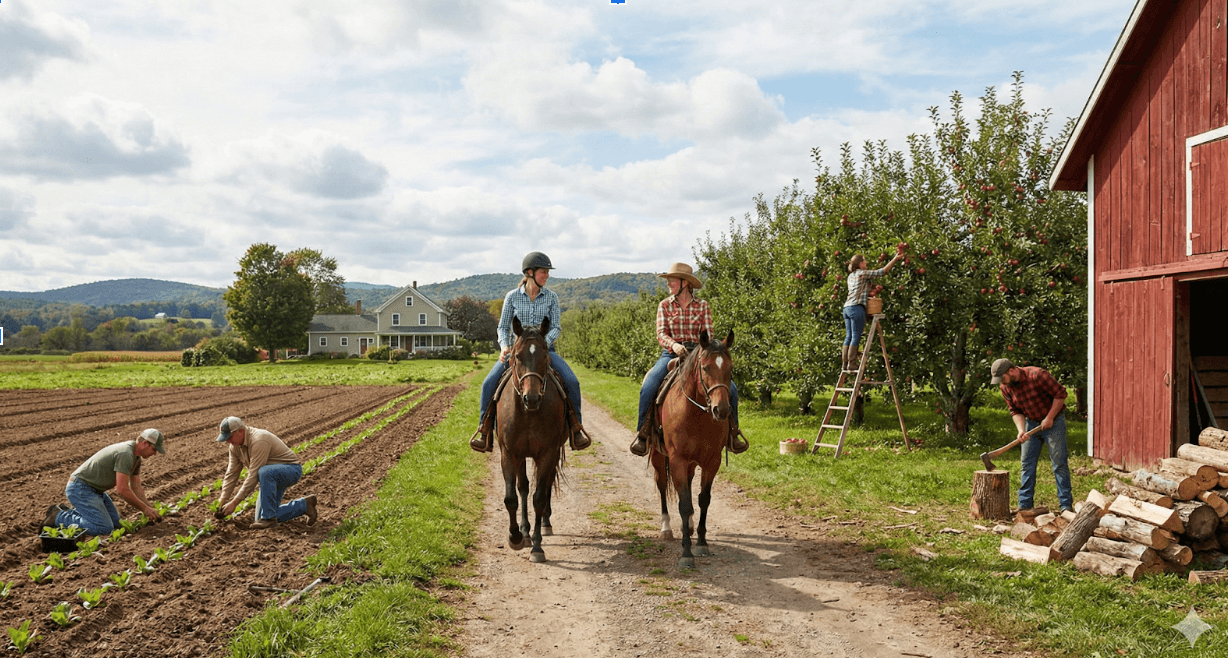
"In the next few minutes, the scene at the farm is going to become even busier."
Step 2: Making Predictions (The "3-Level Certainty" Strategy)
Goal: Use three different future forms to show range. Do not repeat the same grammar structure.
Grammar: The Future Tense Table
Use this table to choose the right grammar based on how sure you are.
Certainty Level: High (Planned)
Grammar Form
Going toUsage & Logic
Use for actions that look like a schedule or clear plan. (Visible evidence).
Example
"The farmers are going to finish planting that row."
Certainty Level: Medium (Logical)
Grammar Form
WillUsage & Logic
Use for logical next steps. (If A happens, B will follow).
Example
"Once he finishes chopping, he will stack the wood."
Certainty Level: Low (Uncertain)
Grammar Form
May / MightUsage & Logic
Use for feelings, decisions, or social interactions. (50% chance).
Example
"The riders might decide to stop and chat."
Step 3: The Closing
Goal: A quick final prediction to wrap up the story.
- Keyword
"Finally..."
- Example
"Finally, the sun will likely set, and the workers will head home for the evening."
CELPIP Speaking Part 4: Model Answer (Score 9+)
Task: Predict what will happen in this scene.
Start of Response
In the next few minutes, I think several things will happen on this farm.1
- Opening Phrase
First, the two men on the left are going to finish planting the crops in that section.2 Since they are kneeling, they look quite tired, so they are probably going to take a short break and drink some water soon.3
- Level 1: Going to (Planned)
- Logical Plan
Moving to the right, the man chopping wood will likely chop a few more logs.4 After that, he will probably carry the wood into the barn to store it for the winter.5
- Level 2: Will (Standard)
- Logical Consequence
As for the women on horseback, they might ride closer to the orchard.6 They may stop to help the woman who is picking apples, or they might just continue their ride along the path.7
- Level 3: Might (Uncertainty)
- Alternative Possibilities
Finally, once the work is done, everyone will likely gather at the farmhouse for a meal.8
- Closing
Universal Templates
Step 1: The Opening
- "In the next few minutes, I imagine that..."
- "Looking at this scene, I predict that..."
Step 2: The Prediction Formula (Mix & Match)
Learn the shape of these three sentence types, not the exact words. A line repeated word for word often sounds rehearsed, and it may not fit the picture you get. For example, "The [People] might decide to [rest]" works for workers on a farm. In a picture of a busy airport, keep the move and change the words: "The family by the window might decide to get a coffee before they board."
A. The "Work/Task" Prediction (Going to)
- "The [Person] is going to finish [Current Action]."
- "The [Person] is going to move to the next [Object/Location]."
B. The "Logical Next Step" (Will)
- "After that, the [Person] will probably [Next Logical Action]."
- "Once they are done, they will likely [Action]."
C. The "Social/Random" Prediction (Might)
- "The [People] might decide to [Social Action: talk/eat/rest]."
- "It might start to [Weather Action: rain/get dark], so they will go inside."
Step 3: The Ending
- "Finally, the day will come to an end."
- "Finally, the scene will become quiet."
Try this on a real Task 4 question, free
Sign up free and answer the first Speaking Task 4 question on the real clock. You get up to three AI-scored tries, with feedback on what to fix before test day.


 Matthew Zare

Discussion
No comments yet. Be the first to share your thoughts.