logo
Mock Tests
Listening
L1Listening to Problem SolvingL2Listening to a Daily Life ConversationL3Listening for InformationL4Listening to a News ItemL5Listening to a DiscussionL6Listening for Viewpoints
Listening Course
Reading
R1Reading CorrespondenceR2Reading to Apply a DiagramR3Reading for InformationR4Reading for Viewpoints
Reading Course
Writing
W1Writing an EmailW2Responding to Survey Questions
Writing Course
Speaking
S1Giving AdviceS2Talking about a Personal ExperienceS3Describing a SceneS4Making PredictionsS5Comparing and PersuadingS6Dealing with a Difficult SituationS7Expressing OpinionsS8Describing an Unusual Situation
Speaking Course
All practice questions
Courses
All free guides
Writing & Speaking Templates

Topics

SpeakingWritingListeningReadingScores & CLBExam InfoStudy Plans
VocabularyTeachers
Free Guides
Courses
Templates
Vocabulary
Teachers
Exams
Practice

Pro Membership

Unlock all premium features

SALE
  1. Free Guides
  2. Templates

CELPIP Speaking Task 3 Template (Describing a Scene)

CELPIP Speaking Task 3: 30 seconds to prepare, 60 to speak. A fill-in template, 5 sample answers, and the four things Paragon actually rates.

CELPIP Speaking Task 3 Template (Describing a Scene)

CELPIP Speaking Task 3 gives you 30 seconds to prepare and 60 seconds to describe an illustration to someone who cannot see it. Paragon rates the task holistically on Content/Coherence, Vocabulary, Listenability and Task Fulfillment. There is no Grammar band. Open with one general statement, then describe a few things well. You do not have to cover everything.

Practice Task 3 against a real 60-second timer. Exam-like picture prompts, first one free

How long is CELPIP Speaking Task 3?

You get 30 seconds to prepare and 60 seconds to speak. The clock starts on its own and there is no pause button, which is why the first sentence has to be automatic rather than invented on the spot.

Paragon's Speaking Test Overview table at celpip.ca lists the preparation and speaking time for every task. Task 3 sits in the middle of the pack:

TaskPrepareSpeak
1. Giving Advice30 seconds90 seconds
2. Talking about a Personal Experience30 seconds60 seconds
3. Describing a Scene30 seconds60 seconds
4. Making Predictions30 seconds60 seconds
5. Comparing and Persuading60 seconds to choose, then 60 seconds60 seconds
6. Dealing with a Difficult Situation60 seconds60 seconds
7. Expressing Opinions30 seconds90 seconds
8. Describing an Unusual Situation30 seconds60 seconds

Only Tasks 1 and 7 get 90 seconds. Everything else is a minute. If you have been practising Task 3 with a 90-second timer because a study group told you to, you have been rehearsing an answer that runs 50 percent long, and on test day the recording will cut you off mid-sentence.

Sixty seconds is roughly 130 to 150 spoken words at a comfortable pace. That is four or five sentences of real content, not ten.

What does the screen actually say?

Paragon describes Task 3 as "Look at an illustration and describe what is happening." That is the whole instruction. The on-screen prompt in the official sample material is longer and worth memorising, because it tells you who your listener is:

Describe some things that are happening in the picture below as well as you can. The person with whom you are speaking cannot see the picture.

Two phrases in there do a lot of work. "Some things" is permission to be selective. "Cannot see the picture" is the reason your spatial language matters at all: if you say "he is over there", your listener has nothing to attach that to.

Both quotations come from Paragon's own test-taker materials. Nobody is going to ask you to describe every object in the frame.

Goal

Describe a picture in detail to a person who cannot see it. You must systematically cover the Who, Where, and What while demonstrating precise spatial vocabulary and accurate grammar.

What CELPIP actually rates on Task 3

CELPIP Speaking is rated on four dimensions: Content/Coherence, Vocabulary, Listenability and Task Fulfillment. Those four names come from Paragon's own Speaking Performance Standards, and they apply to all eight scored tasks, Task 3 included.

DimensionWhat it means on a picture task
Content/CoherenceWhether your description holds together. Did you move through the picture in an order a listener can follow, or jump around?
VocabularyWhether you named things precisely. Barn beats building. Chopping beats doing.
ListenabilityWhether you are easy to listen to. Pace, pausing, clear pronunciation, and sentences that do not collapse halfway through.
Task FulfillmentWhether you actually did the task, which here means describing what is happening, not narrating your opinion of it.

Three things worth knowing about this list, because most CELPIP prep sites get them wrong:

The rating is holistic. There is no points formula, and Paragon publishes no weighting per dimension. A rater listens to the whole response and places it on a scale. You cannot bank a high Vocabulary score to offset a description nobody could follow.

There is no Grammar band. Grammar is not one of the four dimensions. That does not mean grammar is irrelevant, because broken tenses make you harder to follow and that lands on Listenability and Content/Coherence. But nobody is scoring your present continuous in isolation.

"Coherence and Cohesion", "Lexical Resource" and "Fluency and Pronunciation" are IELTS terms. If a template promises to fix your "Lexical Resource" on CELPIP, it was written for a different test.

If you want the fuller picture of how the four dimensions turn into a level, we cover it on the CELPIP Speaking score chart.

### What strong Task 3 answers do well

These are the three habits that separate a Task 3 answer that lands from one that wanders. They are not the official criteria, they are what the criteria reward.

  • Structure (Spatial Flow): They want a logical path. You cannot jump randomly from left to right. You must move like a camera: Background → Foreground or Left → Right.
  • Grammar (Accuracy): They are listening for Present Continuous for actions (is running) and State Verbs with the "S" (he seems).
  • Vocabulary (Precision): You need specific nouns (barn, harvesting, chopping) rather than general ones (house, doing, cutting). Note: This vocabulary depends entirely on the specific picture, so you should practice on our website to cover all possible scenarios.

Step 1: The Opening (The Starter Phrase)

Goal: Begin clearly by identifying the setting and the general atmosphere. Do not just list items immediately.

Grammar Booster: Articles (A vs. The)

Since the examiner cannot see the image, you must introduce new items with "A" (indefinite). Once you have mentioned them, you can use "The" (definite).

  • Rule: Start with A. Continue with The.
  • Example: "I see a man. The man is working hard."

Structure

  1. The Setting: Where is this? (A park, a office, a farm).
  2. The Atmosphere: What is the "vibe"? (Busy, calm, chaotic, wintery).

Example (for your image): "The picture I am looking at depicts a lively farm scene on a sunny day. It looks like it is autumn because people are harvesting crops and chopping wood."

Step 2: Organization (Spatial Indicators)

Goal: Move through the picture logically using "Signpost Words" so the listener doesn't get lost.

Grammar: Present Continuous vs. State Verbs

You must alternate between describing actions and describing impressions.

TypeGrammarUsageExample
ActionPresent ContinuousWhat is happening right now."The man is chopping wood."
Impression3rd Person SingularHow the person/object appears."He seems focused."

Grammar Alert: The "S" for 3rd Person

Even native speakers sometimes forget this. If the subject is He, She, or It, you MUST add an "S" to the state verb.

  • Correct: "The woman looks happy."
  • Incorrect: "The woman look happy."

Zone 1: The Center / Foreground

Start with the most obvious element.

Structure:

  • Spatial Marker: "In the center of the picture..." / "In the foreground..."
  • Action (Present Continuous): "Two women are riding brown horses along a dirt path."
  • Impression (State Verb): "They seem quite relaxed as they enjoy their ride."

Zone 2: The Left Side

Move your "camera" to the left.

Structure:

  • Spatial Marker: "On the left side..."
  • Action (Present Continuous): "Two men are kneeling in a field and planting crops."
  • Impression (State Verb): "The work looks physically demanding."

Zone 3: The Right Side

Move your "camera" to the right.

Structure:

  • Spatial Marker: "On the right side..."
  • Action 1 (Singular): "A man is chopping logs with an axe near a large red barn."
  • Action 2 (Singular): "Behind him, a woman is picking apples from a tall tree."
  • Impression (State Verb): "The harvest appears to be very plentiful this year."

Zone 4: The Background

Finish with the distant details.

Structure:

  • Spatial Marker: "In the background..."
  • Description: "I can see a large white farmhouse and some rolling green hills."

Step 3: The Closing

Goal: A simple summary sentence to finish the description.

  • Example: "Overall, it seems like a very productive day at the farm."

Do you have to describe everything in the picture?

No. Paragon's own advice for this task says "You don't need to describe everything." That single line, contradicts most of what you will read about this task online.

Here is the full strategy list Paragon publishes for Describing a Scene:

  • Start with a general statement
  • Then focus on some details. You don't need to describe everything
  • Build a picture
  • Use descriptive words and phrases
  • Describe the people's appearance, actions, and feelings

Read that order again. General statement first, then a few details, described well. Nowhere does it ask for coverage.

This matters because the most common way people lose marks on Task 3 is a breathless inventory. Sixty seconds of "and there is a tree, and there is a bench, and there is a dog, and there is a bicycle" is a list, not a description, and a rater hears exactly that. It reads as thin on Content/Coherence and thin on Vocabulary at the same time, because listing forces you into the same four words over and over.

Three or four elements, each with an action and an impression, will always beat twelve elements named and abandoned. If you finish at 55 seconds having covered four things properly, you have done the task.

The one thing you should not do is invent. If you cannot tell whether the man is a teacher or a parent, say "he appears to be a teacher" and move on. Paragon asks you to describe what is happening, and a small, clearly hedged inference is part of describing. A confident wrong fact is not.

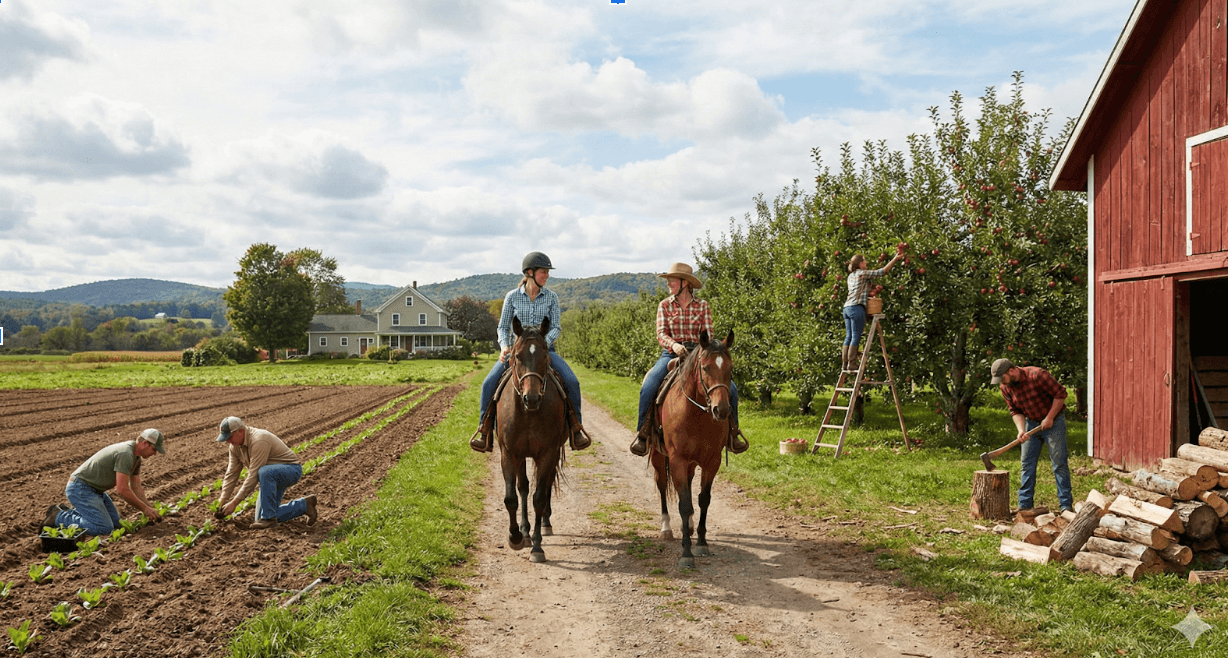
CELPIP Speaking Part 3: Model Answer (Score 9+)

Task: Describe the picture.

Start of Response:

The picture I am looking at depicts a lively farm scene on a beautiful sunny day. Starter Phrase + Atmosphere

In the foreground, there are two women who are riding horses down a dirt path. Spatial Marker + Present Continuous They seem very relaxed and are smiling at each other. Impression (State Verb with S)

On the left side, two men are working in a large field. They are kneeling down to plant crops in the soil. Action (Plural) The work looks tiring, but they seem focused on their task. Impression (State Verb with S)

On the right side, the scene is quite busy. A man is chopping wood with an axe, while a woman behind him is picking apples from a tree. Action (Singular + Articles) There is also a large red barn that looks very traditional. State Verb

In the background, I can see a white farmhouse surrounded by green hills. Background Detail

Overall, everyone seems to be enjoying their work in the fresh air. Closing

Three more CELPIP Task 3 sample answers

Every answer below runs between 134 and 142 words, which is what 60 seconds sounds like at a comfortable pace. Read one aloud with a timer before you trust that number, because most people speak faster than they think under pressure and finish at 45 seconds with nothing left to say.

Each one follows the same four-zone path as the template above. The settings change. The shape does not.

Sample 1: A bus stop on a rainy morning (142 words)

The picture shows a crowded bus stop on what looks like a cold, rainy morning in the city.

In the foreground, a young woman is standing under a bright yellow umbrella and checking her phone. She seems a little impatient, and she keeps glancing down the road.

On the left side, an older man in a grey raincoat is sitting on the bench with a shopping bag beside him. He looks tired, as though he has been waiting for a while.

On the right side, two students are sharing one umbrella and laughing about something. Their backpacks appear to be soaked through.

In the background, I can see a row of shops with their lights on, and a bus is approaching through the traffic.

Overall, it seems like an ordinary weekday morning, and everyone looks ready to get out of the rain.

Sample 2: A community centre on a weekend afternoon (138 words)

The picture I am looking at shows a busy community centre hall, and the atmosphere seems cheerful and a bit noisy.

In the foreground, a woman is setting out paper cups on a long folding table. She appears to be volunteering, because she is wearing a name tag.

On the left side, four children are painting at a low table covered with newspaper. One of them is holding up his picture, and he looks very proud of it.

On the right side, two men are stacking chairs against the wall. They seem to be clearing space for something, possibly a class later in the day.

In the background, I can see a large notice board covered in posters and a set of glass doors leading outside.

Overall, it looks like a well-used neighbourhood space on a busy Saturday.

Sample 3: A beach on a hot summer day (134 words)

The picture depicts a sandy beach on what appears to be a very hot summer afternoon.

In the foreground, a family is sitting under a large striped umbrella. The mother is reading a book, and a small boy beside her is digging in the sand with a plastic spade.

On the left side, two teenagers are playing volleyball near the water. They seem quite competitive, and one of them is jumping to hit the ball.

On the right side, an older couple is walking slowly along the shoreline. They look relaxed, and the woman is carrying her sandals in one hand.

In the background, I can see several small boats on the water and a line of green hills behind them.

Overall, everyone seems to be enjoying a warm, easy day by the sea.

If you want more phrasing options for the slots above, the Task 3 vocabulary and phrase list gives you alternatives for each one, and a fuller walkthrough of describing a scene, with a park-scene word bank covers scene types this page does not.

Universal Templates

Step 1: The Opening (The "Big Picture")

  • "The picture I am looking at shows a [Place: park/office/street] on a [Weather: sunny/rainy/snowy] day."
  • "This is a busy scene inside a [Place: cafe/airport/station]. Everyone seems to be in a rush."

Step 2: The "Action & Feeling" Formula

Memorize this pattern for every section of the image.

Pattern A (Singular Person): "I see a [Person]. He/She is [Verb-ing]..."
"...He/She looks [Adjective: happy/stressed/bored]."

Pattern B (Group of People): "There are [Number] people who are [Verb-ing]..."
"...They seem [Adjective: excited/focused/tired]."

Step 3: Spatial Transitions

  • "Moving to the left side, I can see..."
  • "Shifting to the right side, there is..."
  • "In the background, I notice..."
  • "In the foreground, right in front of me, there is..."

Where to find CELPIP Task 3 pictures to practise on

A template is useless until you have run it against pictures you have never seen before. That is the whole difficulty of Task 3: the structure is fixed, the vocabulary is not, and the vocabulary is what falls apart when the picture is unfamiliar.

Paragon publishes a small number of sample illustrations in its free materials, and they are worth doing first because they are the closest thing to the real style. There are not many of them, and once you have described the same three pictures four times each, you are testing your memory rather than your English.

For practicing more, our Task 3 question bank holds exam-like picture prompts, covering the settings that come up most often: markets, waiting rooms, parks, kitchens, building sites, classrooms, transport. Each one runs on the real 30-second and 60-second clocks, and your recording comes back with AI scoring on the four dimensions above, which is faster than waiting for a teacher to listen to it.

How to practise so it actually transfers:

  1. Do not look at the picture before the timer starts. Surprise is the skill you are training.
  2. Say the first sentence out loud within three seconds of the speaking clock starting. If you hesitate at the opening you will hesitate all the way through.
  3. Record yourself and listen back once. Count how many different nouns you used. Under eight in 60 seconds means you were listing, not describing.
  4. Do five different pictures rather than one picture five times. Same reason as above.

If you would rather work through the whole section in order, the CELPIP Speaking practice hub has all eight tasks in one place.

All Templates

writing

  • W1 Writing an Email
  • W2 Survey Question

speaking

  • S1 Giving Advice
  • S2 Personal Experience
  • S3 Describing a Scene (Current)
  • S4 Making Predictions
  • S5 Comparing and Persuading
  • S6 Difficult Situation
  • S7 Expressing Opinions
  • S8 Describing an Unusual Situation

The task before this one, Speaking Task 2, talking about a personal experience, is a narrative task and uses a completely different shape. The task after it, Speaking Task 4, making predictions, uses the same illustration you just described, which is why people often run the two together in practice. All of them sit in our full set of CELPIP Speaking templates.

Ready to try one? Open the Task 3 question bank and start the 60-second timer. Do not look at the picture first.

Good to know

Frequently Asked Questions

1How long is CELPIP Speaking Task 3?

You get 30 seconds to prepare and 60 seconds to speak. Paragon's Speaking Test Overview lists 30 and 60 for Task 3. Only Tasks 1 and 7 give you 90 seconds of speaking time, so a 60-second answer is the target here.

2What does CELPIP Speaking Task 3 ask you to do?

Paragon describes it as "Look at an illustration and describe what is happening." The on-screen prompt in the official sample material reads: "Describe some things that are happening in the picture below as well as you can. The person with whom you are speaking cannot see the picture."

3Do you have to describe everything in the picture?

No. Paragon's own strategy list for this task says "Then focus on some details. You don't need to describe everything." Three or four elements described properly, each with an action and an impression, score better than a rushed inventory of twelve.

4What is CELPIP Speaking Task 3 scored on?

The same four dimensions as every scored Speaking task: Content/Coherence, Vocabulary, Listenability and Task Fulfillment. The rating is holistic, so there is no points formula, and Paragon publishes no weighting per dimension. There is no separate Grammar band on CELPIP Speaking.

5Is describing a scene Task 3 or Part 3?

It is Task 3. Paragon's materials list eight scored Speaking tasks and Describing a Scene is the third. Plenty of prep material and study groups say "part 3" instead, and for this task the two names point at the same thing. If you searched for "part 3", you are on the right page.

6Where can I get CELPIP Task 3 pictures to practice with?

Our Task 3 question bank has tens of picture prompts on the real 30-second and 60-second timers, with AI scoring on the four dimensions.

Previous template

Personal Experience (Task 2)

Next template

Making Predictions (Task 4)

All Templates

View all

writing

W1Writing an EmailW2Survey Question

speaking

S1Giving AdviceS2Personal ExperienceS3Describing a SceneCurrentS4Making PredictionsS5Comparing and PersuadingS6Difficult SituationS7Expressing OpinionsS8Describing an Unusual Situation
CELTESTPIP - CELPIP Practice Test Platform

Your fastest path to a 10+ CELPIP score. Practice with 4,000+ questions, full mock exams, and instant AI scoring.

SupportPartnership Program

Practice Tests

  • Mock Exams
  • Question Bank
  • Listening Practice
  • Reading Practice
  • Writing Practice
  • Speaking Practice

CELPIP Courses

  • Writing Course
  • Speaking Course
  • Listening Course
  • Reading Course
  • Vocabulary & Collocations Kit
  • Vocabulary Foundations

Resources

  • CELPIP Teacher
  • CELPIP Study Materials
  • Student Reviews
  • Writing & Speaking Templates
  • Vocabulary Builder
  • About CELTESTPIP
  • CELPIP vs IELTS
  • Compare CELPIP Platforms
  • CELPIP for Immigration
  • IELTS Preparation

Listening
  • Problem Solving
  • Daily Life Conversation
  • Information
  • News Item
  • Discussion
  • Viewpoints
Reading
  • Correspondence
  • Apply a Diagram
  • Information
  • Viewpoints
Writing
  • Writing an Email
  • Survey Questions
Speaking
  • Giving Advice
  • Personal Experience
  • Describing a Scene
  • Making Predictions
  • Comparing and Persuading
  • Difficult Situation
  • Expressing Opinions
  • Unusual Situation

© 2026 CELTESTPIP.com

STARMOON TECHNOLOGIES INC.

Terms of ServicePrivacy PolicyRefund Policy

CELTESTPIP is an independent practice platform and is not affiliated with, endorsed by, sponsored by, or accredited by Paragon Testing Enterprises Inc., the owner of the CELPIP® test, or the University of British Columbia. Our practice tests are study material only: they are not official exams and do not produce official scores. CELTESTPIP does not reproduce or distribute real exam questions, passages, recordings, answer keys, or score reports. Every scored practice item on this site is written by CELTESTPIP. Where our practice format mirrors the exam owner's on-screen instructions or worked examples, short extracts of that instructional text may appear for format fidelity and remain the property of their owner. CELPIP® and all other exam or brand names referenced on this site are the trademarks of their respective owners, used for identification only.